
Every vendor pitch right now seems to invoke “AI.” A scheduled job that moves files between folders gets called “intelligent automation,” a 2015-era logistic regression model is rebranded as “AI-powered,” and a keyword-matching chatbot is suddenly “powered by GenAI.” None of those labels actually tell you what you’re getting underneath, and the underlying technologies differ substantially in cost, in reliability, and in what they’re capable of. Treating them as interchangeable leads to bad procurement decisions, unnecessary overspending, and systems that fail in ways nobody anticipated.
Automation
Automation is the workhorse of business operations — a system that executes pre-defined logic exactly as written, every time, without judgment or learning. The form factor varies considerably, from cron jobs backing up databases overnight to Zapier flows posting to Slack when a Jira ticket changes status to RPA bots shuttling data between systems that lack a native integration, but the underlying principle is consistent: if a condition is met, the corresponding action runs. None of this qualifies as AI in any meaningful sense, and yet automation remains the right answer for the majority of operational problems.
Determinism is the whole point. Because the same input always produces the same output, automation is straightforward to test, easy to audit, and predictable enough to build entire businesses around. Most business processes don’t actually need judgment; they need consistency and the ability to trace exactly what happened when something goes wrong. A rule firing when it shouldn’t have, or failing to fire when it should have, is a far more debuggable failure mode than tracing why a probabilistic system produced a particular output.
For anything operating under regulatory scrutiny, automation carries an additional advantage: it produces explanations a regulator can actually read. “Rule 47 matched on field X” is a legible answer in a way that model probability scores rarely are.
Machine Learning
Machine learning shifts where the rules come from. Instead of a human writing them, the system derives them statistically from examples. Spam filtering is the canonical illustration — a filter is fed millions of labeled emails, learns the patterns that distinguish spam from legitimate mail, and then scores new messages against what it has seen. The same approach underlies credit risk scoring, demand forecasting, fraud detection, recommendation engines, and defect detection on production lines, along with essentially any other problem where there’s a substantial pool of historical data and a need to predict, classify, or score new inputs.
The trade-off is that ML outputs are probabilities rather than certainties. A spam filter at 99% accuracy still misclassifies one in every hundred messages, which means some legitimate mail will be flagged and some spam will make it through. Model performance also drifts over time as the underlying world changes — the patterns that defined fraud in 2022 are not the patterns that define it today — which means any ML system requires ongoing care in a way that traditional automation does not. Monitoring catches accuracy degradation, periodic retraining keeps the model current, and ongoing validation confirms the model still applies to the population it’s actually being used on.
The payoff, when ML is the right fit, is that the system can handle patterns that would be impossible to encode by hand. Nobody could write the rules required to identify spam at Gmail’s scale; the patterns shift too quickly and there are simply too many of them for any team of humans to maintain. ML works precisely because it does not require a human to articulate the underlying logic.
AI
AI is the broader umbrella that contains machine learning. When most people use “AI” in conversation today, they’re referring to the most recent wave of the field — large language models, image generators, code assistants, and the early generation of autonomous agents — systems capable of taking a vague, unstructured prompt and producing a useful response they’ve never seen before.
This represents a genuine departure from traditional ML. Where a spam classifier needs a structured email to score and a claims model needs a fixed feature set, an LLM can take a request like “draft a polite email declining this meeting and propose three alternatives next week” and produce a usable result on its own.
That capability comes with operational characteristics that need to be designed around. LLMs are subject to hallucination — producing outputs that read as authoritative but don’t always correspond to verified information — which means downstream verification or human review is part of any responsible deployment. Outputs are non-deterministic by design, so the same prompt can yield different responses across runs. Compute costs are non-trivial at any scale and become significant at enterprise scale. Explainability remains an active area of research rather than a feature available off the shelf, which has real implications for compliance and audit workflows.
For the right kind of problem — something open-ended, generative, or language-heavy — those trade-offs are well worth making. Outside that envelope, the same trade-offs are harder to justify.
How they relate
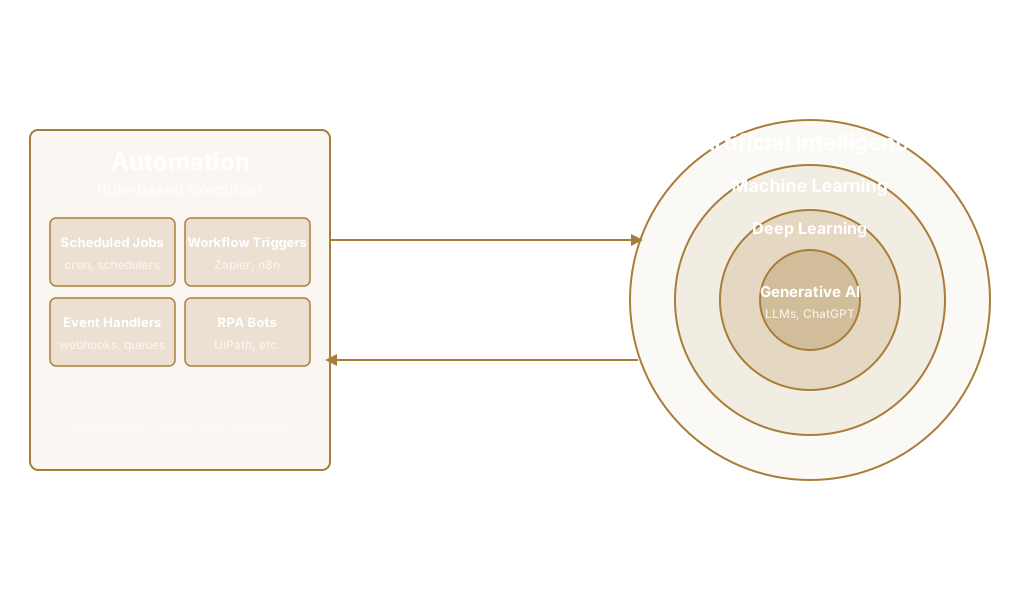
Generative AI sits inside deep learning, which sits inside machine learning, which sits inside AI. Automation is its own discipline alongside that hierarchy, encompassing scheduled jobs, workflow triggers, event handlers, and RPA, each with decades of engineering practice behind it. The two communicate constantly in production: automation triggers AI tasks and feeds them the data they need to operate on, while AI returns decisions, classifications, and generated content that automation then acts on. When a vendor describes their product as “AI” without further specification, the label itself isn’t doing much work; it could refer to any of the four inner layers, or it could simply mean traditional automation dressed up for a modern audience.
How each handles the same kind of input
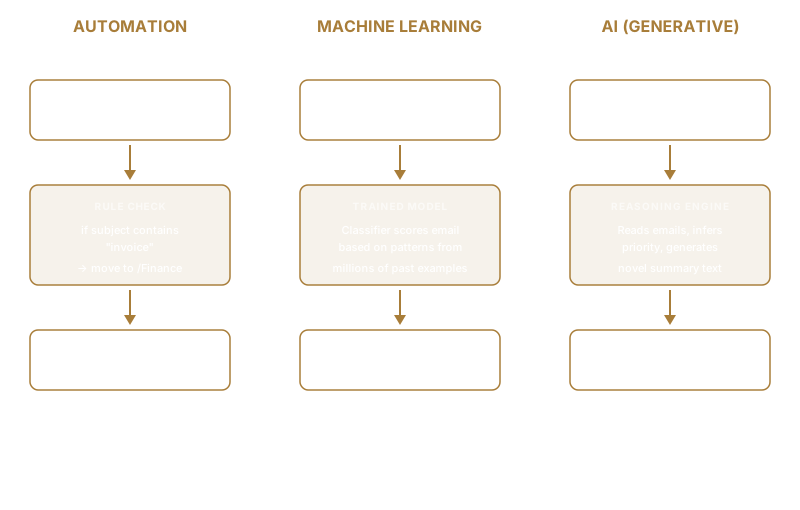
The same input flows through three very different processing paths. Automation is the cheapest and most predictable, while AI is the most flexible at the cost of being the slowest, the most expensive, and the least deterministic of the three. ML sits between them on essentially every axis.
How they work together
Drawing a hard line between automation and AI makes the categories easier to talk about, but the most useful systems blur that line by design — and they incorporate human verification at the points where the cost of being wrong is high. A workable mental model is that AI handles judgment under ambiguity, automation handles deterministic execution, and humans stay in the loop wherever an AI output drives an irreversible or consequential action.
Consider a support ticket coming into an organization. An LLM reads it, identifies the issue category, and determines which team should handle it — that’s the AI part, judgment under ambiguity. The mechanics of routing the ticket, starting the SLA timer, sending the Slack notification, and writing the audit log entry are all handled by automation. For high-stakes or low-confidence cases — a possible legal threat, a flagged executive complaint, an unusual refund request — the AI’s classification is queued for a human reviewer before any consequential action follows. Routing mechanics belong to automation; decisions that warrant human judgment stay with a human.
This pattern shows up across most well-designed systems once you start looking for it:
- Automation triggers AI for batch synthesis. A workflow tool gathers a day’s worth of customer feedback, support tickets, or sales calls and hands the corpus to an LLM each morning. The synthesis lands in an executive summary or dashboard for a human to review and act on. Batching, persistence, and delivery are automation. The synthesis is AI. The decisions that follow stay with people.
- AI decides, automation executes. An LLM reads incoming leads or support tickets and assigns each a category and routing destination. Low-stakes routing flows through automatically. For decisions that affect a customer materially — refunds, account suspensions, escalations to legal — the AI’s recommendation is queued for a human reviewer before automation acts on it.
- Automation feeds AI structured context. An ETL pipeline pulls data from a CRM, a data warehouse, and a third-party enrichment service, normalizes the result, and hands the model a clean packet to score or summarize. Outputs above a confidence threshold flow through unattended; outputs below the threshold are surfaced to a human reviewer who decides what to do next.
- AI plans, humans approve, automation runs. An AI agent proposes a multi-step workflow — say, the actions required to onboard a new customer or remediate a security finding. The plan is reviewed by a human, and only then does deterministic infrastructure execute it: API calls, retry logic, idempotency checks, error handling, audit logging. The AI shapes the plan, the human owns the decision, and automation owns the execution.
Trying to force AI to handle the deterministic work is expensive and unreliable. Trying to force automation to handle ambiguous judgment is brittle and limited. And trying to remove humans from decisions that materially affect customers, compliance, or the business is how organizations end up with systems they later regret. The systems that work well are explicit about all three roles — AI where flexibility matters, automation where certainty matters, humans where judgment is consequential — with well-defined handoffs between them.
Picking the right one
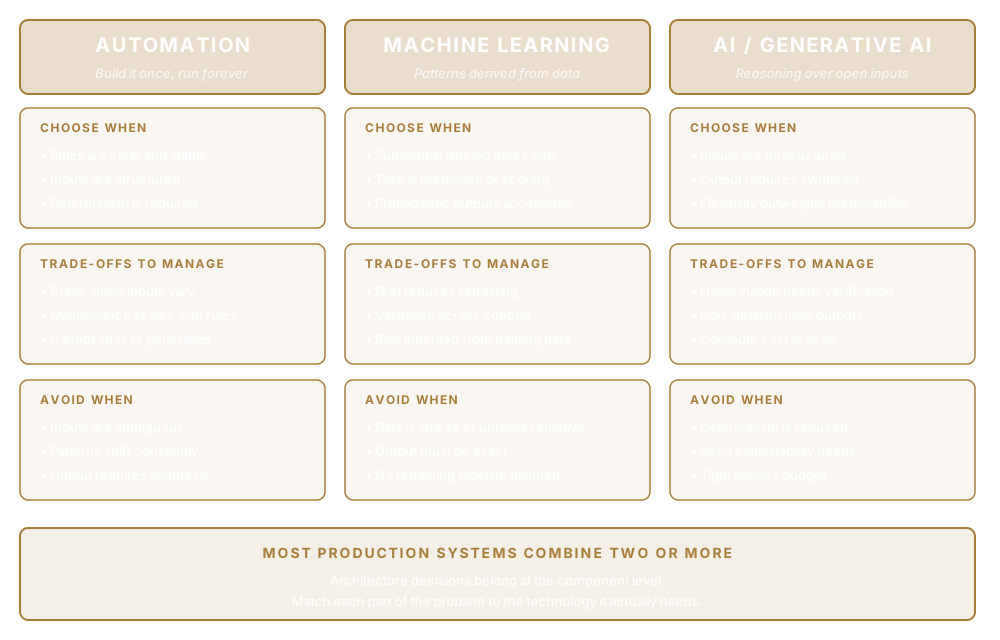
Most architecture decisions in this space are easier than they’re made out to be. Stable rules and structured inputs call for automation, full stop — there’s rarely a defensible reason to pay for LLM inference on work a workflow engine can already handle deterministically. A task that involves prediction, classification, or scoring against substantial historical data is squarely in ML territory, a mature discipline with more than a decade of reliable business value behind it. AI earns its place in the open-ended problems: language work, ambiguous inputs, and synthesis tasks where flexibility is worth the unpredictability.
Why getting this right matters
The organizations getting genuine value from AI tend to share a discipline around where it actually belongs in their stack. Deterministic automation handles whatever it can, ML covers the cases where the data justifies a statistical model, and AI is reserved for the problems where its specific strengths matter most.
That kind of precision is hard to retrofit after the fact. Once a vendor has convinced an organization that everything should be “AI-powered,” the resulting architecture tends to be expensive to operate and painful to unwind.
If you’re evaluating AI investments and want an honest assessment of what belongs where, reach out. We can help you identify which parts of your operation genuinely benefit from AI, and which would be better served by simpler tools.